
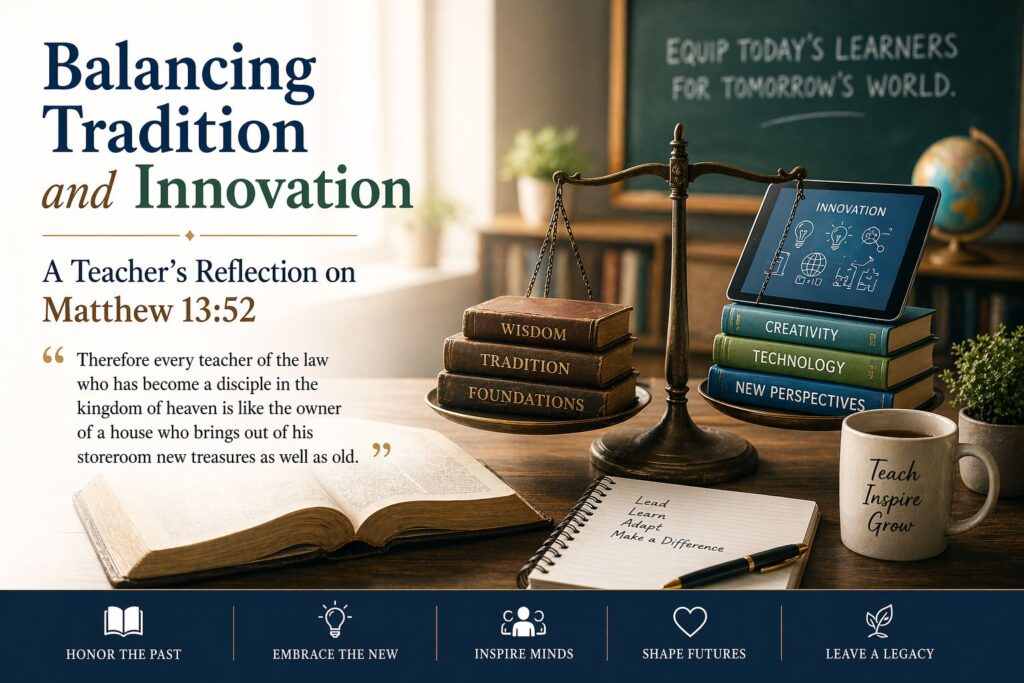
In the Gospel of Matthew 13:52, Jesus Christ presents a powerful metaphor about teaching: “Every teacher of the law who has become a disciple in the kingdom of heaven is like the owner of a house who brings out of his storeroom new treasures as well as old.” This verse captures the transformation of a teacher, the nature of knowledge, and the responsibility of sharing it meaningfully.
The “teacher of the law” refers to those deeply rooted in scripture and tradition. However, Jesus adds that such a teacher must also become a “disciple.” This marks a shift from simply possessing knowledge to continually learning. A disciple is humble, open, and willing to grow. True teaching cannot exist without ongoing learning.
The metaphor of the householder introduces the idea of responsibility and stewardship. The “storeroom” represents accumulated knowledge, wisdom, and experience. It is filled with valuable “treasures” that are both “old” and “new.” The “old” treasures refer to established truths, traditions, and teachings that provide continuity and depth. The “new” treasures point to fresh insights, renewed interpretations, and evolving ideas that expand understanding.
The verse does not suggest replacing the old with the new. Instead, it emphasises the importance of holding both together. A wise teacher recognises the value of tradition while embracing innovation. This balance ensures that knowledge remains both rooted and relevant. The act of “bringing out” these treasures also implies discernment. A teacher must know what to present, when to present it, and how to make it meaningful.
From a modern teacher’s perspective, this message is highly relevant. Educators today constantly navigate the balance between tradition and change. On one hand, they are expected to uphold established curricula, teach foundational concepts, and maintain academic standards. On the other hand, they must adapt to new methods, integrate technology, and respond to evolving student needs.
In this context, the “old treasures” can be understood as core subject knowledge, classical literature, and proven teaching practices. These provide structure and credibility. The “new treasures” include digital tools, interactive strategies, and student-centered approaches. For example, a teacher may teach a classic text but use multimedia resources or group discussions to make it engaging. In doing so, the old is not discarded but enriched.
Another key idea in this verse is that a teacher must also be a disciple. In modern terms, this reflects lifelong learning. Teachers must continue to grow, update their knowledge, and refine their methods. They must also be open to learning from their students, whose perspectives can challenge and deepen understanding.
The image of the householder also highlights intentionality in teaching. A teacher acts as a curator of knowledge, selecting what is most valuable and appropriate for students. Not everything in the “storeroom” needs to be shared at once. Effective teaching requires timing, clarity, and sensitivity to students’ needs.
The verse also points to the creative dimension of teaching. Bringing out “new and old treasures” suggests variety and richness. A classroom should be dynamic and engaging, combining different methods such as discussion, storytelling, and critical thinking activities. This approach keeps learning meaningful and relevant.
There is also an ethical aspect to this teaching philosophy. By valuing both tradition and innovation, a teacher encourages students to respect the past while remaining open to change. This helps them develop balanced thinking and adaptability, which are essential in a changing world.
In conclusion, Matthew 13:52 offers a profound vision of teaching. It presents the teacher as both a learner and a guide, someone who balances tradition with innovation and shares knowledge with discernment and purpose. This model of teaching remains deeply relevant today, reminding educators that effective teaching lies in being both rooted and adaptable while continuing to grow alongside their students.
Leave a Reply